Arthur Pendelton bought the old Hawthorne house for its bones. At forty-five, after the quiet passing of his wife, he needed a project that required his hands more than his heart. The Victorian structure sat at the end of a forgotten cul-de-sac in Maine, a looming silhouette of peeling slate and overgrown ivy. It was a place that demanded attention, which was exactly what Arthur craved. He wanted to scrape away the rot and rebuild something sturdy, something that would outlast him.
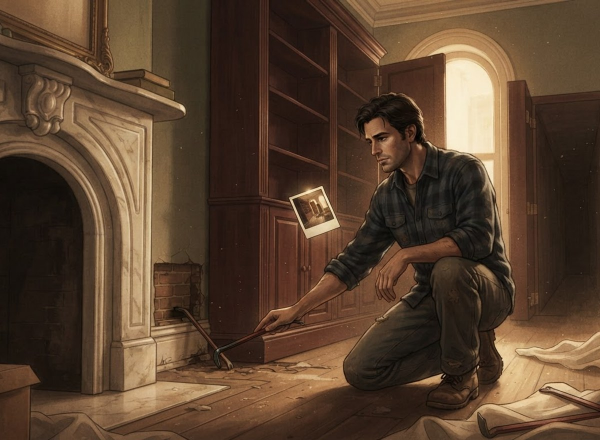
On a rainy Tuesday, three weeks into the renovation, Arthur was on his knees in the parlor, prying up the water-damaged baseboards. The house smelled of wet earth and ancient pine. As his crowbar dug behind a particularly stubborn piece of oak, he heard a hollow crunch. He paused, wiping a streak of plaster dust from his forehead. Pulling the wood back, he discovered a small rectangular cavity carved directly into the brickwork. Nestled inside was a tarnished copper tin.
Arthur set his tools down. The tin was cool to the touch, its edges sealed with decades of grime. He worked the lid free with the flat end of his pry bar. Inside, resting on a bed of dried, crumbling mothballs, was a single Polaroid photograph.
He picked it up, expecting a portrait of a stern Victorian family or a snapshot of a bygone summer. Instead, he found a picture of the exact room he was sitting in. The distinctive arched window, the ornate marble fireplace, and the original oak floorboards were unmistakable. But as Arthur studied the photograph, a cold thrill ran down his spine.
In the picture, the wall to the left of the fireplace—a section currently covered in solid floor-to-ceiling mahogany bookshelves—was different. The entire bookcase was swung outward on massive iron hinges, resembling a heavy bank vault door. Behind it, the photograph showed a dark, narrow corridor leading into the very walls of the house.
Arthur looked up from the photograph and stared at the bookshelves. They were flush against the plaster, seamless and immovable. He stood up, walking slowly to the wall. He ran his calloused fingers over the mahogany, searching for a gap, a latch, or a seam. There was nothing. He knocked his knuckles against the wood. It sounded dense, backed by solid brick.
The mystery gnawed at him. He spent the next hour pacing the room, comparing the faded photograph to the physical reality of the parlor. He retrieved his laser tape measure from his toolbox and calculated the dimensions of the room. Then, throwing on a raincoat, he marched outside into the downpour and measured the exterior footprint of the house.
Sitting at his makeshift plywood desk, Arthur crunched the numbers. His pulse quickened. The math did not lie. Between the interior wall of the parlor and the exterior siding of the house, there was a gap of exactly four and a half feet. A void that spanned the entire length of the western wing. The hidden corridor was still there.
Armed with a high-powered flashlight and a mallet, Arthur returned to the mahogany bookcase. He examined every inch, looking for a scuff mark on the floor, a worn patch on the wood, or an out-of-place molding. Down near the baseboard, beneath a thick layer of dust, he found it: a faint, sweeping arc scratched into the floor varnish, indicating where a heavy weight had repeatedly swung outward.
He started pressing on the wooden rosettes that decorated the mantelpiece. He pulled at the trim. Finally, he reached up to the highest shelf and pressed against the back panel. A subtle, metallic click echoed from deep within the wall. Arthur pushed harder against the left side of the bookcase. With a groan of rusted hinges and protesting wood, the entire heavy mahogany structure shifted.
Arthur wedged his fingers into the crack and pulled with all his strength. A puff of stale, dust-choked air rushed out as the bookshelf swung open, revealing a pitch-black space. He clicked on his flashlight. The beam cut through the darkness, illuminating a narrow corridor that stretched out of sight.
His heart hammering, Arthur stepped across the threshold. The air was surprisingly dry, smelling faintly of turpentine and dried lavender. The corridor extended for about twenty feet before opening into a windowless, rectangular room concealed perfectly within the architecture of the house.
Arthur swept his flashlight around the hidden space. It was a time capsule. In the center of the room stood a large wooden easel, supporting a canvas covered by a canvas drop cloth. Against the far wall were metal racks holding dozens of other canvases, all carefully wrapped in protective linen. A small writing desk sat in the corner, holding a dried inkwell and a sealed envelope.
He approached the desk first. The envelope was yellowed with age, the name 'Beatrice' written across the front in an elegant, sweeping cursive. Beside the envelope was a brass key.
Carefully, Arthur opened the envelope and unfolded the letter inside. It was dated October 14th, 1978.
'My dearest Beatrice,' the letter began. 'If you are reading this, I am no longer with you, and you have finally found the courage to look beyond the surface of things. Your father never understood my art. He believed a woman's hands were meant only for tending a home, not for painting the world. When he demanded I destroy my work, I pretended to comply. Instead, I built this sanctuary.'
Arthur read on, captivated. The writer, Clara Hawthorne, detailed how she had secretly continued to paint, pouring her soul onto canvas while the rest of the world slept. She knew she was dying of an illness she had kept hidden, and she wanted to ensure her life's work survived for her daughter. The art was her legacy, a testament to her spirit, and a financial safety net for Beatrice's future.
Arthur lowered the letter, deeply moved. He walked over to the easel and gently lifted the drop cloth. He gasped. The painting was a breathtaking oil landscape of the Maine coastline, bursting with vibrant colors and raw emotion. It was a masterpiece, possessing a quality of light and movement that rivaled the great impressionists. He moved to the racks, pulling back linen covers to reveal portrait after portrait, landscape after landscape, each more stunning than the last.
Clara Hawthorne had been a genius, locked away in the dark.
The next morning, Arthur began his search. He drove to the local library, poring over public records, obituaries, and property deeds. He learned that Clara Hawthorne had passed away in late 1978, just months after writing the letter. Her husband had sold the house a few years later. Beatrice, the daughter, had been sent to a boarding school and later moved out of state.
It took three weeks of dedicated sleuthing, calling distant relatives and scouring social media, but Arthur finally found her. Beatrice Hawthorne, now in her early sixties, was living two towns over. She was a retired schoolteacher, working part-time at a local florist to make ends meet.
Arthur called her on a Tuesday afternoon. He explained that he had bought her childhood home and had found something belonging to her mother. He asked if she would be willing to visit. She agreed, though her voice carried a tremor of hesitation.
When Beatrice arrived, she was a quiet, dignified woman with sad eyes. Arthur offered her tea and led her into the parlor. He handed her the faded Polaroid first.
'I found this hidden in the wall,' Arthur explained gently. 'It led me to something incredible.'
Beatrice stared at the photograph, her brow furrowing. 'This is... this is the parlor. But that door... I never knew about a door.'
Arthur walked over to the mahogany bookcase. He reached up, pressed the concealed latch, and pulled the heavy structure open. Beatrice gasped, taking a step back as the hidden corridor was revealed.
'Your mother left something for you,' Arthur said, handing her the flashlight. 'I think you should be the first one to see it in the light.'
Trembling, Beatrice walked into the hidden room. Arthur followed closely behind, turning on a portable work light he had set up earlier. The room flooded with bright, warm light. Beatrice saw the easel, the racks of canvases, and the writing desk.
Arthur handed her the letter. He watched as she read her mother's words, tears welling in her eyes and spilling down her cheeks. She touched the signature, tracing the ink with a shaking finger.
'She didn't abandon her art,' Beatrice whispered, her voice breaking. 'She always told me she stopped painting because she lost her inspiration. She lied to protect it. To protect me.'
Arthur helped her uncover the canvases. Together, they filled the hidden room with Clara's masterpieces. Beatrice wept openly as she looked at the vibrant colors, recognizing the fierce, beautiful spirit of the mother she had lost too soon.
In the weeks that followed, Arthur helped Beatrice catalog the collection. They brought in an art appraiser, who was astounded by the quality and volume of the work. The collection was valued at a life-changing sum. Clara's paintings were eventually featured in a prominent gallery in Boston, finally receiving the recognition they deserved.
For Beatrice, the discovery brought financial security and a profound sense of closure. For Arthur, the experience brought something equally valuable. As he continued to restore the Hawthorne house, the crippling loneliness that had plagued him since his wife's death began to fade. He had uncovered a secret, preserved a legacy, and in doing so, found a renewed purpose.
The house was no longer just a project; it was a testament to endurance and hidden beauty. And as Beatrice returned often to visit her new friend, sitting in the fully restored parlor, drinking tea and laughing by the fire, Arthur knew he was finally home.
The end.
A little hope to take with you.
Stay for a little conversation.
Be kind. Avoid spoilers, or clearly label them. Comments appear after review.